Ayn Rand Cult by Jeff Walker
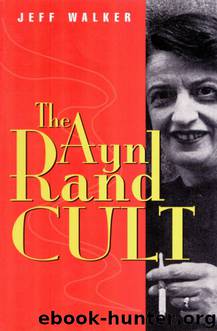
Author:Jeff Walker [Walker, Jeff]
Language: eng
Format: mobi
ISBN: 9780812698190
Publisher: Open Court
Published: 2012-03-30T04:00:00+00:00
7
Alan Greenspan:
The Undertaker Takes Over
There at the Dawn of Time
Born the year Ayn Rand arrived in the U.S., the son of a stockbroker, Alan Greenspan graduated from New York University’s School of Commerce in 1948. He soon took a dull job at the National Industrial Conference Board, a propaganda outlet for big business, and worked on steel inventories. Through a soon-annulled marriage to Joan Mitchell (later Joan Blumenthal)—not until 1997 at age 71 would he take the plunge again—Greenspan met Ayn Rand, herself a veteran of extensive contact with other business propaganda outlets like the National Association of Manufacturers (NAM). NAM and the U.S. Chamber of Commerce would one day have not very nice things to say about Greenspan’s performance as chairman of the Federal Reserve Board.
Business Week refers to Greenspan as a “former Ayn Rand devotee” who became a key member of her original inner circle in the mid-1950s. “He was very much part of the Collective. But he had his own life,” recalled lawyer-novelist Erika Holzer. He would come late to every meeting and leave early. Having his own relationship with Rand, which was dignified, he kept somewhat aloof from the others. For his appearance and demeanor, he became known to other Collective members as ‘the Undertaker’. Recalls Edith Efron, “He was her special pet,” partly “because . . . there wasn’t anybody known to her closely who was a businessman who was out in the world of power.”
“It was like sitting in on the dawn of time,” reminisces Collective member Harry Kalberman, a brokerage-business executive and Nathaniel Branden’s brother-in-law. “We would take whatever Ms. Rand had written and read it. And she would watch our faces—to see whether we got it.” Nathaniel Branden recalls that Alan “would compliment Ayn on some passage in the novel, saying, ‘On reading this . . . one tends to feel. . . exhilarated’. Or ‘the reader is inspired here’,” demonstrating an early flair for convoluted, depersonalized language. Robert Bleiberg, a business magazine editor in 1961, was sufficiently impressed by a Greenspan lecture that he reprinted a few of his essays in Barron’s. Why did Bleiberg resist invitations to ally himself with the Collective? “It became evident to me that they were a cult,” he explains.
In 1968 Greenspan was one of a gang of four Collective members who at Rand’s insistence irrevocably repudiated both Brandens in the Objectivist. At the time Greenspan was off working on the Nixon campaign. Barbara Branden suggested later that Greenspan signed Rand’s statement about the break because he believed what she told him. “He’d never heard my side of the story and he was the most stunned man on earth when I told it to him.”
Roy Childs recalls that an early draft of the Rand biography Barbara showed him contained “some great Greenspan anecdotes. . . . Ayn took him apart at an elegant elite restaurant, got mad at him, blew her top, called him a coward.” Barbara Branden responds, “Everybody went through that.” A subtle retraction typically ensued.
Download
This site does not store any files on its server. We only index and link to content provided by other sites. Please contact the content providers to delete copyright contents if any and email us, we'll remove relevant links or contents immediately.
4 3 2 1: A Novel by Paul Auster(12391)
The handmaid's tale by Margaret Atwood(7763)
Giovanni's Room by James Baldwin(7346)
Asking the Right Questions: A Guide to Critical Thinking by M. Neil Browne & Stuart M. Keeley(5775)
Big Magic: Creative Living Beyond Fear by Elizabeth Gilbert(5771)
Ego Is the Enemy by Ryan Holiday(5446)
The Body: A Guide for Occupants by Bill Bryson(5096)
On Writing A Memoir of the Craft by Stephen King(4942)
Ken Follett - World without end by Ken Follett(4731)
Adulting by Kelly Williams Brown(4574)
Bluets by Maggie Nelson(4556)
Eat That Frog! by Brian Tracy(4536)
Guilty Pleasures by Laurell K Hamilton(4448)
The Poetry of Pablo Neruda by Pablo Neruda(4106)
Alive: The Story of the Andes Survivors by Piers Paul Read(4031)
White Noise - A Novel by Don DeLillo(4009)
Fingerprints of the Gods by Graham Hancock(4004)
The Book of Joy by Dalai Lama(3986)
The Bookshop by Penelope Fitzgerald(3852)
